


Introduction
For Australian high school students, the Australian Tertiary Admission Rank (ATAR) is one of the most important academic measures used for university admissions. It plays a significant role in determining eligibility for undergraduate courses and can influence future educational and career opportunities. As a result, many students are eager to understand their potential ATAR before official results are released. This is where an ATAR Calculator becomes an invaluable tool.
An ATAR Calculator helps students estimate their ATAR based on subject scores, assessment results, and predicted examination performance. While it cannot guarantee an exact outcome, it provides a useful indication of where a student may rank compared to their peers. By offering early insights into academic performance, an ATAR calculator allows students to set goals, adjust study strategies, and make informed decisions about university applications.
In this article, we will explore what an ATAR Calculator is, how it works, its benefits and limitations, and how students can use it effectively to plan for their future.
What Is an ATAR?
The Australian Tertiary Admission Rank, commonly known as the ATAR, is a ranking system used across Australia to assist universities in selecting students for admission into undergraduate programs. The ATAR is expressed as a number between 0.00 and 99.95 in increments of 0.05.
Unlike a percentage score, the ATAR represents a student's ranking relative to other students in the same age group. For example:
-
An ATAR of 80.00 means the student performed better than 80% of the eligible population.
-
An ATAR of 95.00 means the student outperformed 95% of eligible students.
-
An ATAR of 99.00 places a student among the top 1% of the cohort.
Universities use ATAR scores as a standard measure for comparing applicants from different schools and educational backgrounds. Competitive programs such as medicine, dentistry, law, engineering, and certain business degrees often require higher ATARs due to limited places and strong demand.
What Is an ATAR Calculator?
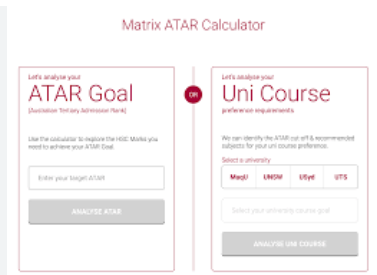
ATAR Calculator is an online tool designed to estimate a student's likely ATAR before official results are released. Students enter information such as assessment marks, examination predictions, and subject selections. The calculator then uses historical scaling data and ranking methodologies to generate an estimated ATAR.
These calculators have become increasingly popular among Year 11 and Year 12 students because they provide a snapshot of academic progress. Students can use the estimates to determine whether they are on track to meet university entrance requirements and identify areas where improvement may be needed.
Most ATAR calculators are tailored to specific Australian education systems, including:
-
Higher School Certificate (HSC) – New South Wales
-
Victorian Certificate of Education (VCE) – Victoria
-
Queensland Certificate of Education (QCE) – Queensland
-
South Australian Certificate of Education (SACE) – South Australia
-
Western Australian Certificate of Education (WACE) – Western Australia
-
Tasmanian Certificate of Education (TCE) – Tasmania
Because assessment structures and scaling methods differ between states, using the correct calculator is essential for obtaining a more accurate estimate.
How Does an ATAR Calculator Work?
Although different calculators use slightly different formulas, the general process remains similar.
1. Subject Selection
Students begin by selecting the subjects they are studying. This is important because each subject is treated differently during the scaling process.
2. Entering Marks
Students enter their current assessment scores or predicted examination results. The quality of the estimate largely depends on how accurate these inputs are.
3. Applying Subject Scaling
Scaling adjusts subject scores to account for differences in subject difficulty and the academic strength of the students taking those subjects. Subjects with stronger overall cohorts may receive positive scaling adjustments.
4. Calculating Aggregate Scores
The calculator combines scaled subject results according to the rules used by the relevant state or territory education authority.
5. Generating an Estimated ATAR
Finally, the aggregate score is compared with historical data and ranking distributions to estimate a student's likely ATAR.
While the process may appear straightforward, ATAR calculations involve complex statistical methods. Therefore, calculator results should always be viewed as estimates rather than guaranteed outcomes.
Benefits of Using an ATAR Calculator
Academic Goal Setting
One of the primary benefits of an ATAR calculator is helping students establish realistic academic goals. By seeing the marks required to achieve a target ATAR, students can create a focused study plan.
Monitoring Progress
Students can use the calculator throughout the year to track changes in performance. Regular updates provide insight into whether academic goals are being met.
University Course Planning
Most universities publish minimum ATAR requirements for their courses. An estimated ATAR allows students to compare their projected results with these entry standards and adjust course preferences if necessary.
Improved Motivation
When students can see the direct impact of improved assessment scores, they are often more motivated to stay committed to their studies.
Reduced Anxiety
Uncertainty about future results can be stressful. Although an estimate is not definitive, it can provide reassurance and help students prepare for different scenarios.
Factors That Affect ATAR Calculations
Several variables influence both estimated and final ATAR results.
Subject Scaling
Scaling is one of the most significant factors affecting ATAR calculations. Different subjects attract students with varying academic strengths, leading to different scaling outcomes.
School Assessments
Performance in assignments, projects, tests, and internal assessments contributes significantly to overall subject results.
Final Examinations
External examinations often account for a large percentage of the final subject score. Strong examination performance can substantially improve a student's ranking.
Cohort Performance
Since the ATAR is a ranking system, a student's results are influenced by the performance of other students. Higher or lower overall cohort achievement can affect rankings.
State and Territory Policies
Each Australian state and territory uses slightly different methods for calculating study scores and ATAR rankings. These differences can impact final outcomes.
Limitations of ATAR Calculators
While ATAR calculators are useful planning tools, they are not perfectly accurate.
Dependence on Predictions
Most calculators rely on predicted exam results. If actual performance differs from expectations, the estimated ATAR may be significantly different from the final result.
Changing Scaling Patterns
Scaling adjustments can vary from year to year depending on subject enrolments and cohort performance.
Unknown Cohort Performance
It is impossible to predict exactly how other students across the state or territory will perform. This uncertainty affects ranking accuracy.
Additional Admission Requirements
Many university programs consider factors beyond the ATAR, including interviews, portfolios, aptitude tests, auditions, and adjustment factors. Therefore, a strong ATAR alone may not guarantee admission.
Tips for Maximizing Your ATAR
Develop Consistent Study Habits
Regular study throughout the year is more effective than last-minute cramming. Consistency helps improve understanding and retention.
Focus on Weak Areas
Identifying and addressing weaker subjects early can significantly improve overall performance.
Practice Examination Techniques
Completing past papers and timed practice exams builds confidence and improves time management skills.
Seek Academic Support
Teachers, tutors, and study groups can provide valuable guidance and clarification on difficult topics.
Stay Organized
Using study schedules, planners, and revision timetables can help students manage workloads effectively.
Maintain Well-Being
Adequate sleep, healthy eating, physical activity, and stress management all contribute to better academic performance.
Conclusion
ATAR Calculator is a powerful tool that helps students estimate their potential university admission ranking before official results are released. By using assessment scores, predicted exam marks, and historical scaling data, these calculators provide valuable insights into academic progress and future opportunities.
Although no calculator can guarantee an exact ATAR, the estimates can help students set realistic goals, monitor performance, and make informed decisions about university applications. Understanding the factors that influence ATAR calculations, including subject scaling, examination performance, and cohort rankings, allows students to use these tools more effectively.
Ultimately, an ATAR calculator should be viewed as a guide rather than a prediction of certainty. Success in achieving a desired ATAR depends on consistent effort, effective study strategies, strong examination preparation, and a commitment to continuous improvement. By combining the insights provided by an ATAR calculator with dedication and hard work, students can confidently work toward their academic goals and take important steps toward their future careers.

 English
 French
 Spanish
 Portuguese
 Deutsch
 Turkish
 Dutch
Dutch
 Italiano
 Russian
 Romaian
 Portuguese (Brazil)
 Greek
Greek