


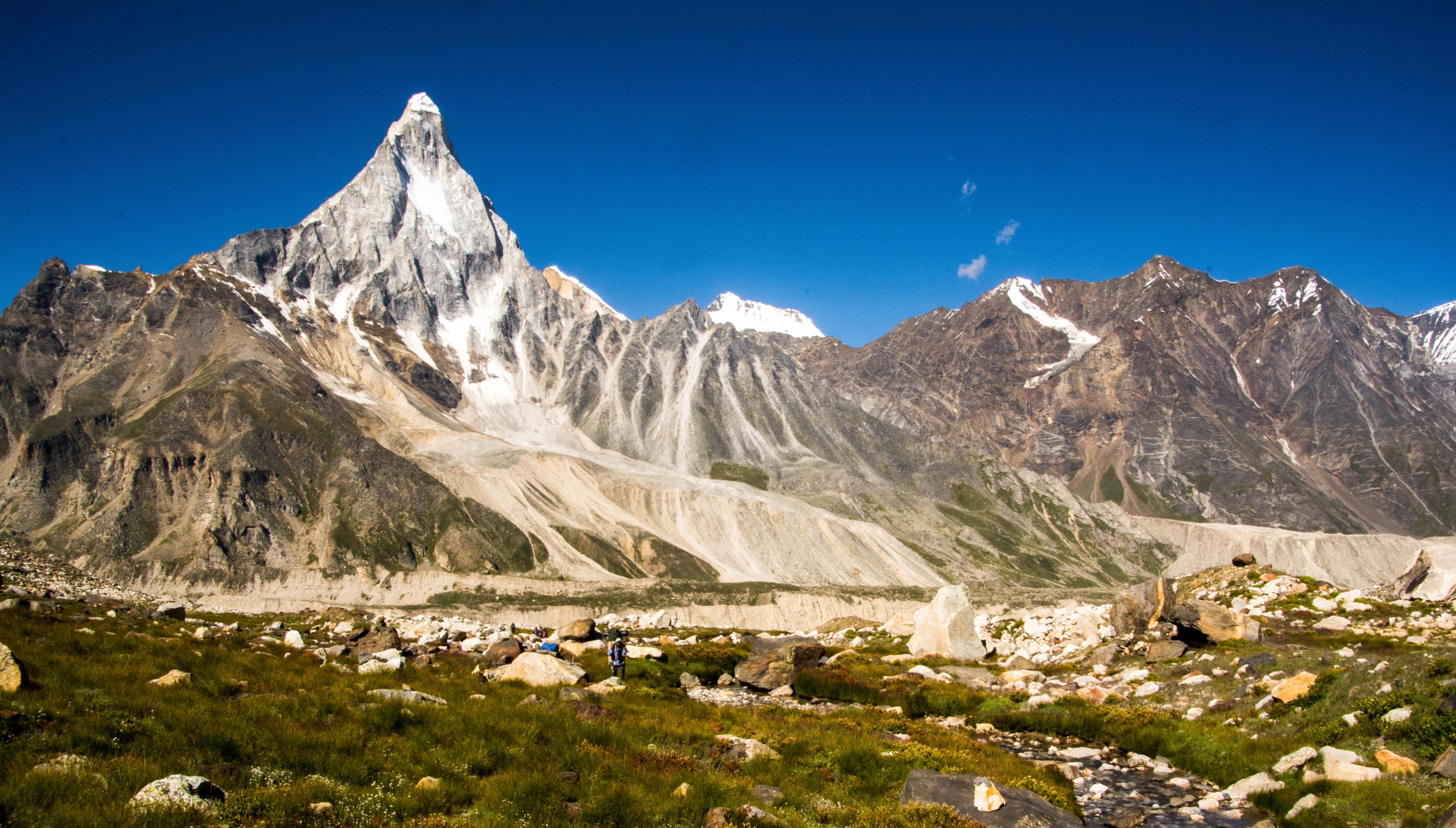
If Gangotri is where the Ganga is worshipped, Gaumukh is where she is born. The snout of the Gangotri Glacier — the largest glacier in the Indian Himalayas outside the Siachen range — takes the shape of a cow's mouth (Gaumukh = cow's mouth) from which the Bhagirathi River emerges, creating the Ganga. Trekking to Gaumukh is one of the most spiritually and physically profound journeys in the Indian Himalayas.
What is Gaumukh?
At 3,892 metres, Gaumukh is the terminal snout of the Gangotri Glacier — a 30 km long river of ice that has been retreating at an alarming rate due to climate change. From this ice wall, the meltwater emerges as the Bhagirathi River. Pilgrims who reach Gaumukh perform ritual prayers at the ice face and take water from the emerging stream — considered the most sacred form of Ganga jal.
The Trek Route
Gangotri → Chirbasa → Bhojwasa → Gaumukh
- Gangotri to Chirbasa (9 km): Moderate trail through a gorge with Bhagirathi views; Chirbasa is the first rest camp at 3,600 m. Named for the Chir pine trees once found here.
- Chirbasa to Bhojwasa (5 km): Trail transitions from forest to open high-altitude terrain. Bhojwasa (3,775 m) has the GMVN camp — the overnight stop before Gaumukh.
- Bhojwasa to Gaumukh (5 km): Final push across rocky moraines. The glacier snout is visible as you approach — a dramatic blue-white ice wall.
- Total one way: 19 km | 6–8 hours
Permits Required
The Gaumukh Tapovan Trekking Zone is a restricted area under the Gangotri National Park. Permits are mandatory:
- Available at the District Magistrate office in Uttarkashi or the Forest Department check post at Gangotri
- Indian nationals: ₹150 per day
- Foreign nationals: ₹600 per day
- Daily entry limit: 150 trekkers per day (enforced strictly in recent years)
Book permits well in advance through the official Uttarakhand Forest Department portal.
Camping at Bhojwasa
The GMVN Bhojwasa Camp offers tent accommodation (₹500–₹1,000/night) with basic meals. Private camping is also allowed near Bhojwasa. The altitude here (3,775 m) means cold nights — 0°C to -5°C even in summer. Carry a four-season sleeping bag.
Difficulty Level
Rated moderate for the trek to Bhojwasa; moderate-strenuous for the full Gaumukh extension. No technical climbing required, but the altitude and moraine terrain demand physical fitness and good acclimatization.
Best Time to Trek
May to June (before monsoon) and September to October (post-monsoon clarity) are ideal. July-August monsoon brings rain and landslide risk; the trail may be closed during heavy rain periods.
Environmental Guidelines
The Gaumukh area is one of India's most environmentally sensitive ecosystems. Strict rules apply:
- No plastic bags or packaged water bottles on the trek
- No cutting of trees or plants
- No fires outside designated areas
- Pack out all waste — nothing to be left on the trail
The retreat of the Gangotri Glacier is a visible, measurable consequence of climate change. Visiting with reverence and minimal impact is not just an ethical choice — it is a spiritual one.
Hotels in Sonprayag Hotels in Syanachatti- Hotels in New Tehri Hotels in Trijuginarayan Hotels in Valley Of Flowers Hotels in Yamunotri Hotels in Kedarkantha Hotels in Kedarnath Hotels in New Tehri Hotels in Pandukeshwar Hotels in Phata Hotels in Pipalkoti Hotels in Ranachatti - Hotels in Sersi Hotels in Rudraprayag Hotels in Gangotri Hotels in Barkot Hotels in Sitapur Hotels in Bhojwasa Hotels in Govind Ghat Hotels In Guptkashi Hotels in Gaurikund Hotels in Harsil Hotels in Hemkund Sahib Hotels in Jankichatti Hotels in Joshimath Hotels in Kalpeshwar Hotels in Devprayag Hotels in Chardham Hotels in Uttarkashi

 English
 French
 Spanish
 Portuguese
 Deutsch
 Turkish
 Dutch
Dutch
 Italiano
 Russian
 Romaian
 Portuguese (Brazil)
 Greek
Greek