


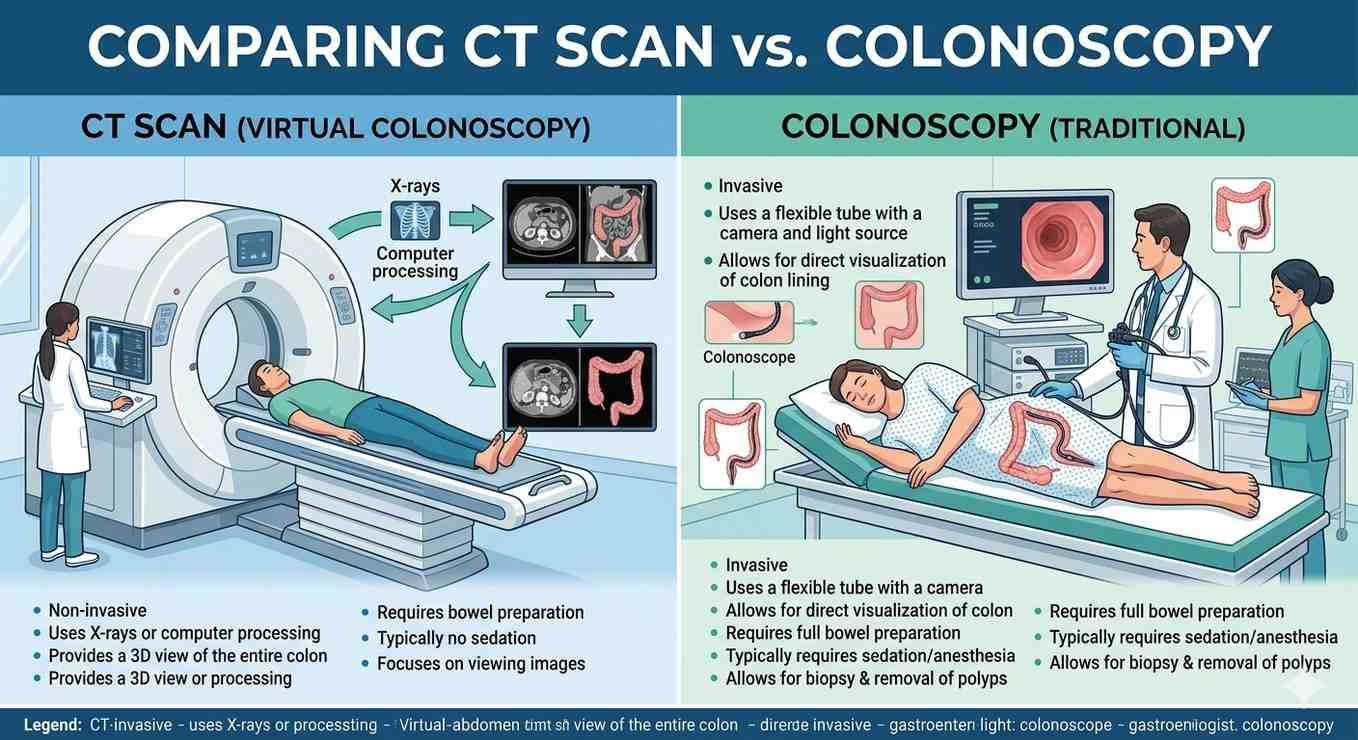
Colorectal cancer is also among the most preventable but lethal forms of cancer, hence the importance of regular screening as a form of early detection and effective treatment. There are two major screening techniques: conventional colonoscopy and CT colonography, which is also referred to as virtual colonoscopy. These two methods are similar in that they are used to detect polyps and cancer within the colon and rectum, but there is an essential difference between them: their methods of operation, invasiveness, and abilities. The issue that bothers many individuals is which method offers superior screening outcomes, which one they are more comfortable with, and which meets their health requirements. The present blog will contrast the two colonoscopy and CT colon screening procedures, discuss differences between them, their level of efficiency in cancer detection, and the benefits each procedure has in the prevention of colorectal cancer.
What is the difference between a CT colonography and a conventional colonoscopy?
CT colonography involves viewing the colon and rectum with high-tech imaging to produce high-quality three-dimensional images of these organs without the need of any instruments to be inserted into the body. Colonoscopy scan requires one to lie on a table with a CT scanner taking pictures after inflating the colon with air or carbon dioxide. Conventional colonoscopy involves the use of a flexible tube with a camera that is forced through the rectum to give a direct view of the whole interior of the colon. Colonoscopy provides the ability to remove the polyp at the same time of the procedure whereas CT colonography only identifies abnormalities and the person has to undergo colonoscopy again in case of the polyps. Both colonoscopy and CT colon screening involve bowel preparation to clean the colon prior to examination so as to clearly observe.
What screening technique is more effective at the diagnosis of early colorectal cancer?
Colonoscopy and CT colon screening are effective to identify colorectal cancer and yet each method possesses its own advantageous and disadvantageous features:
Detection Accuracy: CT colonography has a ninety percent detection rate of larger polyps greater than ten millimeters and is equivalent to traditional colonoscopy in detecting the same larger polyps at ninety five percent.
Small Polyp Detection: Colonoscopy is more effective in detecting polyps which are less than six millimeters across, but most of the tiny polyps are not yet quite harmful or cancerous.
Immediate Treatment: Colonoscopy enables the doctor to get rid of the polyps during the process, which stops cancer formation, and the results of the colonoscopy scan necessitate follow-up operations to eliminate the polyps.
Flat Lesions: Traditional colonoscopy is better placed to detect flat lesions or depressed lesions that may go undetected by the imaging studies yet may indicate early cancer.
Extra-Colonic Findings: CT colonography is able to identify abnormalities beyond the colon, e.g., kidney stones or aneurysms, which add information to health beyond colorectal screening.
Completion Rates: Colonoscopy scan procedures[1] have a higher completion rate since they do not necessitate the scope operation to go the entire length through the colon, which is at times challenging under conventional colonoscopy.
Do CT colonographies become less invasive as compared to colonoscopies?
Yes, CT colonography is much less invasive than the conventional colonoscopy, and it has a variety of comfort and safety benefits. Colonoscopy scan does not require any form of sedation and patients can drive home right after the examination and resume normal activity without having to rest. No tools are sent into the body except in the small rectal tube to insufflate the air, and this removes the risks of perforation or bleeding in the process of scope insertion and polyp extraction.
Nevertheless, colonoscopy, as well as CT colon screening, necessitate the same bowel preparation that involves use of special diets plus laxatives which are also uncomfortable. CT colonography results in fewer discomforts during actual examination and has virtually no risk of complications. Other screening services such as full body scans, lung scans and heart scans[2] are offered in other facilities such as ViaScan in Irving, TX that offers comfortable CT colonography services in addition to other screening services.
Conclusion
Colonoscopy and CT colon screening are both effective in the detection of colorectal cancer but the former has slightly more accuracy with regards to detecting small polyps and the possibility to remove them instantly. The colonoscopy scan technology, also known as CT colonography, is a less invasive procedure that does not need any form of sedation or even inserting an instrument yet identifies the majority of clinically significant polyps and cancers. To get a less invasive screening, there is a facility like ViaScan in Irving, TX that is offering the CT colonography, and extensive imaging facility such as CT scans, full body scans and specialized lung scans and heart scans to proactively health care.
Sources:

 Arabic
 French
 Spanish
 Portuguese
 Deutsch
 Turkish
 Dutch
Dutch
 Italiano
 Russian
 Romaian
 Portuguese (Brazil)
 Greek
Greek