


Introduction
The BIS FMCS Scheme plays a crucial role for foreign manufacturers who wish to export or sell their products in the Indian market. India has strict quality and safety standards, and the Bureau of Indian Standards (BIS) ensures that products entering the market comply with these regulations. Under this framework, the Foreign Manufacturers Certification Scheme (FMCS) was introduced to regulate overseas manufacturers.
This blog provides a detailed explanation of the BIS FMCS Scheme, its importance, eligibility, certification process, required documents, and benefits.
What is the BIS FMCS Scheme?
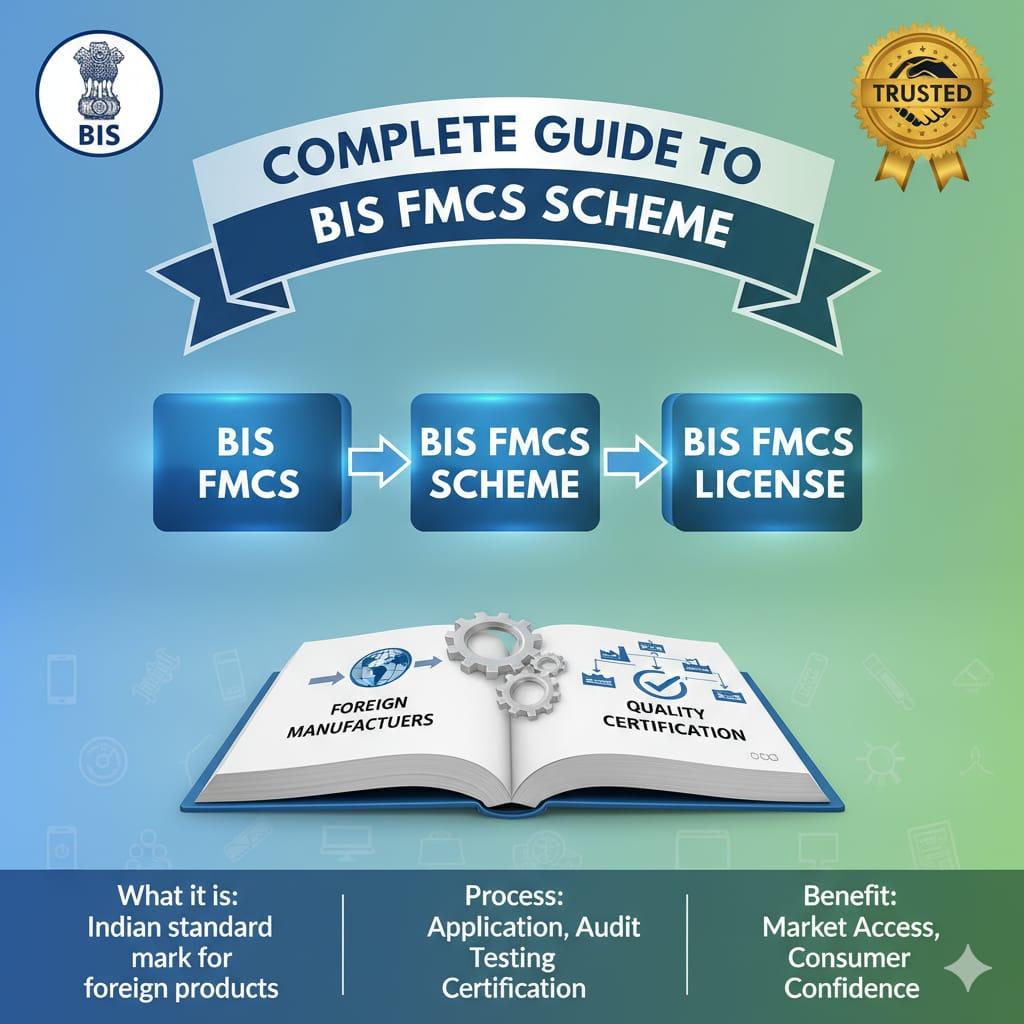
The BIS FMCS Scheme stands for Foreign Manufacturers Certification Scheme, introduced by the Bureau of Indian Standards. This scheme allows foreign manufacturers to obtain a BIS license for products that fall under mandatory certification before being sold in India.
Under this scheme, the manufacturing unit is assessed directly by BIS officials. Once approved, the manufacturer is permitted to use the BIS Standard Mark (ISI Mark) on certified products. This ensures that foreign-made products meet the same quality benchmarks as products manufactured in India.
Importance of BIS FMCS Scheme
The BIS FMCS Scheme is essential for maintaining product quality, consumer safety, and fair trade practices in India. It helps prevent the import of substandard or unsafe goods into the Indian market.
For foreign manufacturers, obtaining certification under the BIS FMCS Scheme is not optional if their product is listed under mandatory BIS certification. Without a valid BIS FMCS License, such products cannot be legally imported, sold, or distributed in India.
Products Covered Under BIS FMCS Scheme
The BIS FMCS Scheme applies to a wide range of products, including but not limited to:
-
Electrical and electronic products
-
Cement and construction materials
-
Steel products
-
Automotive components
-
Household appliances
-
Industrial equipment
Each product category must comply with a specific Indian Standard notified by BIS.
Eligibility for BIS FMCS License
To apply under the BIS FMCS Scheme, a foreign manufacturer must meet the following eligibility criteria:
-
The manufacturing unit must be located outside India
-
The product must fall under mandatory BIS certification
-
Adequate manufacturing and testing facilities must be available
-
The manufacturer must appoint an Authorized Indian Representative (AIR)
-
Compliance with relevant Indian Standards is mandatory
BIS FMCS License Application Process
The process to obtain a BIS FMCS License involves several structured steps:
1. Application Submission
The foreign manufacturer submits an application to BIS along with required documents and fees.
2. Nomination of AIR
An Authorized Indian Representative is appointed to coordinate with BIS on behalf of the foreign manufacturer.
3. Factory Inspection
BIS officials conduct an on-site inspection of the manufacturing unit located abroad. They verify production processes, quality control systems, and testing facilities.
4. Sample Testing
Product samples are drawn during inspection and sent to BIS-recognized laboratories for testing as per Indian Standards.
5. Grant of License
If inspection and test results are satisfactory, BIS grants the FMCS License, allowing the use of the BIS Standard Mark.
Documents Required for BIS FMCS Scheme
Key documents required include:
-
Factory registration documents
-
Manufacturing process flowchart
-
Quality control details
-
Test equipment list
-
Calibration certificates
-
Product technical specifications
-
Authorization letter for AIR
Proper documentation is critical to avoid delays or rejection.
Validity and Renewal of BIS FMCS License
A BIS FMCS License is usually granted for a period of one to two years. Renewal must be applied before expiry, along with updated documents and fees. BIS may conduct surveillance inspections to ensure continued compliance.
Benefits of BIS FMCS Scheme
The BIS FMCS Scheme offers multiple advantages to foreign manufacturers:
-
Legal access to the Indian market
-
Enhanced brand credibility and trust
-
Compliance with Indian safety and quality standards
-
Competitive advantage over non-certified products
-
Reduced risk of import rejection or penalties
Challenges in BIS FMCS Certification
Foreign manufacturers may face challenges such as complex documentation, coordination with BIS, factory inspections abroad, and compliance with Indian testing standards. Proper planning and expert guidance can significantly reduce these challenges.
Conclusion
The sunconsultants.co.in. is a mandatory and vital certification pathway for foreign manufacturers targeting the Indian market. Obtaining a BIS FMCS License not only ensures legal compliance but also enhances product credibility and consumer trust. Understanding the process, documentation, and compliance requirements can help manufacturers achieve certification smoothly and efficiently.

 English
 Arabic
 French
 Spanish
 Portuguese
 Deutsch
 Turkish
 Dutch
Dutch
 Italiano
 Russian
 Romaian
 Greek
Greek