



A Magnetic Stirrer is the unsung hero of countless chemistry and biology laboratories, serving as the primary tool for achieving perfect liquid-liquid homogeneity. While their mechanism is elegantly simple—a rotating magnetic field causes a submerged stir bar to spin—their impact on experimental reliability is monumental. Every successful experiment, whether involving titrations, chemical synthesis, or solution preparation, hinges on having components properly and thoroughly mixed. Choosing the right piece of agitation equipment—be it a stirrer, a specialized mixer, or a temperature-controlled shaker—is therefore a fundamental decision that directly influences the reproducibility and accuracy of your scientific results. This guide explores the critical roles of these three laboratory essentials, helping you select the best tools for your specific needs.
I. Stirrers: The Foundation of Homogeneity
Magnetic stirrers are favored for their precision and ability to operate within closed systems. They are ideal for applications requiring consistent, contamination-free mixing over long durations.
The Mechanism of Magnetic Stirring
The core components of this system include a base unit containing an electromagnet and a small, often PTFE-coated, magnetic stir bar (sometimes called a "flea"). When a vessel containing liquid and the stir bar is placed on the base, the rotating magnetic field compels the bar to spin, efficiently mixing the solution.
-
Precision Control: Modern magnetic stirrers offer variable speed ranges, often reaching up to 1500 rpm or more, allowing users to select everything from gentle agitation for sensitive biological samples to rapid mixing for chemical reactions.
-
Capacity: Stirrers are available in a huge range of sizes. Standard benchtop models handle volumes up to several liters, while specialized Large Volume Magnetic Stirrer units can handle up to 55-gallon drums, making them invaluable for pilot-scale production or bulk preparation.
-
Hotplate Integration: A common and highly practical variant is the hotplate stirrer. This combination unit allows users to control both the mixing speed and the temperature of the solution simultaneously, a crucial requirement for complex synthesis and dissolution protocols.
II. Mixers: High-Intensity, Rapid Agitation
When you need rapid, often high-shear, mixing of small-volume samples, specialized mixers step in where magnetic stirrers might be too slow or gentle.
Mastering the Vortex Mixer
The vortex mixer is an essential piece of equipment in cell culture, microbiology, and biochemistry labs. It rapidly mixes small volumes of liquid (typically in test tubes, microcentrifuge tubes, or small vials) by creating an energetic, localized vortex.
-
Application: These mixers are primarily used for quick, vigorous re-suspension of cells, pellets, or concentrated reagents.
-
Operation: They can be operated in "touch mode" (where the motor activates only when the tube is pressed down onto the rubber cup head) or "continuous mode" for mixing larger batches or when using an accessory platform.
-
Accessories: Interchangeable mixing heads are available, accommodating various sizes of vessels. For high throughput, specialized platforms designed to hold multiple tubes, often secured within a standardized tube rack, can be attached to maximize efficiency during rapid processing.
III. Shakers: Controlled Environmental Motion
For biological samples, especially cell lines or microbial cultures, mixing must often occur under specific, controlled temperature conditions. This is the domain of the laboratory shaker.
The Incu Shaker and Orbital Motion
Shakers are categorized by their movement type—orbital, reciprocal (linear), or rocking. Orbital motion, where the platform moves in a small, smooth circle, is the most common and is gentle enough for cell growth while ensuring adequate gas exchange and nutrient distribution.
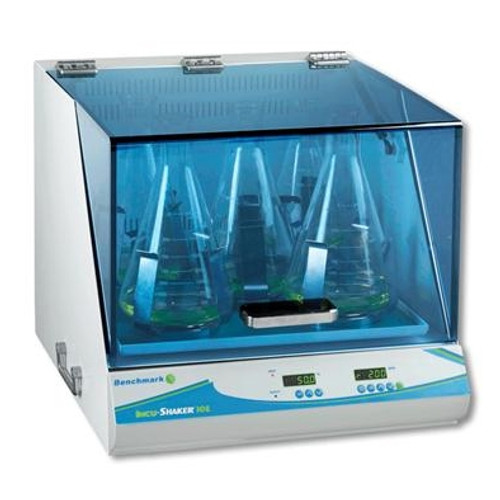
An incu shaker is a hybrid device that combines the constant motion of a shaker with the precise temperature control of an incubator.
-
Cell Culture: They are vital for growing microbial and mammalian cell cultures, ensuring all cells remain suspended and have access to the culture media and atmospheric gases.
-
Temperature Stability: These units maintain a set temperature (e.g., $37^{\circ} \text{C}$ for mammalian cells) with high uniformity and accuracy, which is non-negotiable for reproducible biological experiments.
-
Speed and Load: Like magnetic stirrers, incu shaker speed is variable (e.g., $30 \text{ to } 300 \text{ rpm}$), allowing researchers to optimize agitation for different cell types and media viscosities.
IV. Selecting Your Essential Agitation Equipment
When selecting the right equipment, consider the following parameters:
| Equipment Type | Primary Function | Typical Volume | Key Control |
| Magnetic Stirrer | Achieving liquid homogeneity, long-term mixing, titrations. | Milliliters to many Liters. | Speed (and Heat for hotplate models). |
| Vortex Mixer | Rapid, high-shear mixing of small samples, re-suspending pellets. | Micro- to Milliliters (single tubes). | Speed, Time (touch or continuous mode). |
| Laboratory Shaker | Maintaining biological cultures, long-term assays, extractions. | Multi-Liter Flasks, Vials, Plates. | Speed, Orbit Size, and often Temperature (incu shaker). |
Always verify the mixing capacity and speed range of the unit against the maximum volumes and viscosities you typically work with. For instance, a high-viscosity liquid will require a more powerful magnet or a more robust shaker motor.
Conclusion
From the gentle, sustained motion of a Magnetic Stirrer ensuring a homogeneous solution, to the violent action of a vortex mixer re-suspending a cell pellet, and the controlled environment of an incu shaker nurturing microbial growth, agitation equipment is the backbone of laboratory efficiency. Investing in high-quality, reliable stirrers, mixers, and shakers ensures that one of the most fundamental steps in any experiment—the mixing—is performed accurately and reproducibly, freeing up researchers to focus on analysis and discovery. By matching the tool to the task, you guarantee the integrity of your samples and the validity of your results.
(FAQs)
1. What is the main difference between a magnetic stirrer and a vortex mixer?
A magnetic stirrer provides slow-to-moderate, long-term, and consistent agitation, typically for larger volumes in beakers or flasks. A vortex mixer provides rapid, localized, high-speed, and short-term agitation for small volumes, designed primarily to quickly re-suspend solids or pellets in test tubes.
2. Can I use a regular magnetic stirrer to mix cell cultures?
While a magnetic stirrer can mix cell media, it is generally not recommended for cell cultures because it lacks the necessary temperature control and humidification provided by an incu shaker. Furthermore, the localized shear forces of a rapidly spinning stir bar can damage sensitive cells.
3. How do I choose the correct magnetic stir bar size for my application?
As a general rule, the magnetic stir bar should be no longer than two-thirds the diameter of the vessel being used. Using a bar that is too large or too small can lead to inefficient mixing or cause the bar to "jump" off the magnetic field.
4. What is the role of a tube rack in a mixing environment?
A tube rack acts as an organizer for samples. In the context of agitation equipment, specialized racks or holders are often designed to fit onto the platform of a shaker or an accessory head of a vortex mixer, allowing multiple samples to be agitated simultaneously and securely.
5. What is the advantage of a hotplate stirrer over separate heating and stirring devices?
The main advantage is space and coordinated control. A hotplate stirrer allows a user to monitor and adjust both heat and mixing speed from a single unit, saving valuable bench space. It is also safer and more precise for reactions that require simultaneous, exact temperature and agitation control.

 Arabic
 French
 Spanish
 Portuguese
 Deutsch
 Turkish
 Dutch
Dutch
 Italiano
 Russian
 Romaian
 Portuguese (Brazil)
 Greek
Greek