


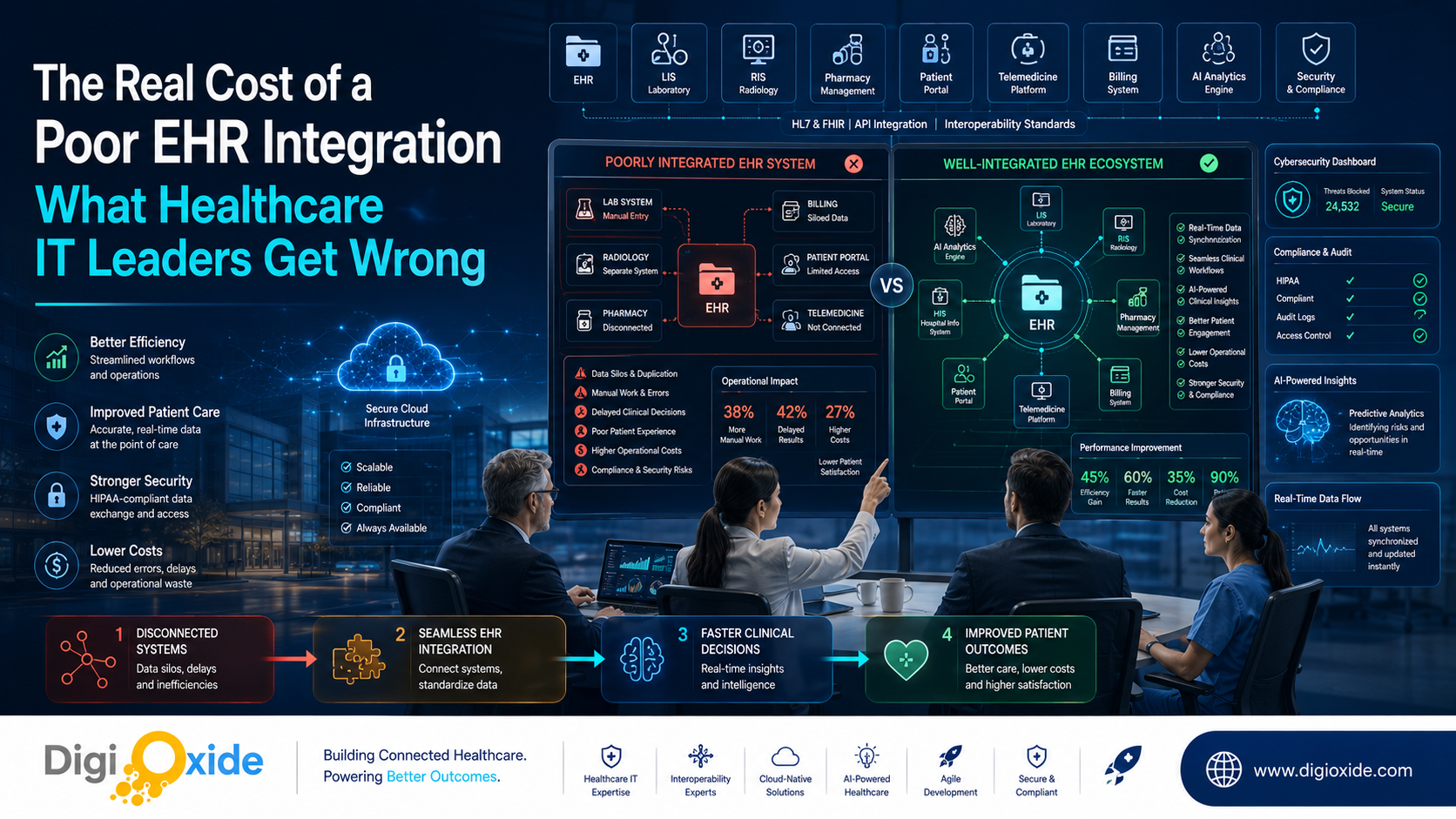
The headline cost of a failed EHR integration is usually measured in dollars: rework contracts, extended timelines, additional consulting fees, and the operational costs of running parallel systems longer than planned. These are real costs and they are significant. But the full cost of a poor EHR integration extends well beyond the technology budget into clinical operations, staff time, patient safety, and the organizational trust that takes years to rebuild after a high-profile failure. Understanding the complete cost picture changes how healthcare IT leaders think about where to invest in quality during the integration process, because the cost of getting it right upfront is almost always lower than the cost of fixing it after the fact.
This article is written for healthcare IT leaders, CIOs, and clinical informatics professionals at health systems and hospital organizations of all sizes. The lessons apply equally to large academic medical centers undertaking complex multi-system integrations and to community hospitals connecting a new telehealth platform to an existing EHR. The specific dollar amounts differ; the failure patterns are remarkably consistent.
What EHR Integration Actually Involves
The term EHR integration covers a range of technical work that is more varied and more complex than the phrase suggests. At its simplest, it refers to establishing a data exchange between an EHR system and another system: a laboratory information system, a radiology system, a patient engagement platform, a claims system, a population health management tool, or any of the dozens of other applications that a health system operates. At its most complex, it refers to the design and implementation of an integration architecture that manages data flow across an entire ecosystem of clinical and administrative systems, maintains data consistency as records are created and updated in multiple places, and ensures that the right information is available to the right system at the right time.
The technical standards involved are specific to healthcare. HL7 version 2, developed in the late 1980s and still the backbone of most clinical interface work, uses a pipe-delimited message format that carries clinical events like admissions, discharges, transfers, orders, and results between systems. Despite being decades old, HL7 v2 remains the most widely implemented standard in US healthcare because it is deeply embedded in the systems that health systems have operated for twenty or thirty years. FHIR, the Fast Healthcare Interoperability Resources standard developed by HL7 International and now required by federal regulation for patient access and payer-to-provider data exchange, uses modern web standards including REST APIs and JSON. Most health systems are operating in an environment where both standards are in use simultaneously.
The implementation gap between what these standards specify and how they are implemented in actual products is one of the primary sources of integration complexity. HL7 v2 has been implemented by different vendors in ways that deviate from the standard in subtle and not-so-subtle ways. A message that is technically valid HL7 v2 may contain data in fields that are not where the receiving system expects it, use code values that are not in the receiving system's reference data, or structure optional segments in ways that differ from what the interface engine is configured to handle. Discovering and resolving these deviations is the detailed work of integration implementation, and it is work that cannot be short-circuited without consequences.
The Most Common Failure Patterns
Across the integration projects that fail to deliver their expected value, several failure patterns appear repeatedly. Identifying them is the first step toward avoiding them.
Underestimating Mapping Complexity
The mapping exercise, translating data fields from the source system's structure and value sets to the target system's structure and value sets, is consistently underestimated in both effort and consequence. When the source system uses a procedure code that the target system does not recognize, the interface needs to handle that gracefully. When the source system's patient identifier structure differs from the target system's, the patient matching logic needs to reconcile them correctly. When clinical codes have been entered inconsistently in the source system over years of clinical operation, the interface needs to normalize them before passing them on.
Health systems that have accumulated EHR data over decades of clinical operation often discover during integration projects that their data is significantly less consistent than they believed. Codes that should have been entered from a controlled vocabulary have been entered as free text. Patient demographic data has been entered differently by different registration staff over time. Problem lists contain entries that do not match standard terminologies. Cleaning and normalizing this data as part of the integration implementation is expensive work that is often not scoped into the original project budget.
The consequence of incomplete or incorrect mapping is not simply that some data does not transfer correctly. In a clinical context, incorrect data can directly affect clinical decision-making. A medication order that does not carry correctly because of a mapping error may result in a duplicate order, a missed dose, or a contraindicated prescription. A result that lands in the wrong section of the clinical record may not be seen by the ordering clinician. The patient safety implications of clinical data integrity failures in EHR integrations are what raise the stakes of this work beyond typical IT implementation.
Insufficient Interface Testing
Interface testing in healthcare IT is fundamentally different from application testing in other software contexts, and organizations that apply general testing practices to clinical interface work consistently discover gaps that surface in production.
Clinical interface testing needs to cover not just the happy path, the standard transaction that carries correct data from a functioning source system to a functioning target system, but the full range of edge cases that clinical operations produce. Patients with two middle names, patients who legally changed their name, patients with hyphenated surnames, patients whose date of birth was entered incorrectly and later corrected, patients who are registered multiple times in the source system with different identifiers: all of these produce interface messages that behave differently from the standard test case and that need to be tested explicitly.
Volume testing is particularly important for interfaces that carry high-frequency clinical events. An interface that performs correctly under normal load may fail when a large batch of laboratory results processes simultaneously, when an overnight discharge run sends hundreds of ADT messages in rapid succession, or when a system upgrade triggers a backfill of historical data. Testing under representative volume conditions before go-live is standard practice in rigorous interface implementations and is frequently skipped in projects under time pressure.
Downtime and recovery testing covers what happens when one or more systems in the integration are unavailable. What does the interface do when the target system is down for planned maintenance? Are messages queued and delivered when the target comes back online? Is the queue bounded so that a prolonged outage does not fill storage? Are the messages delivered in the correct order after recovery? These scenarios need to be tested deliberately, not discovered during the first planned maintenance window after go-live.
Inadequate Clinical Validation
Technical validation, confirming that the interface sends and receives messages correctly, is a necessary condition for a successful EHR integration but not a sufficient one. Clinical validation, confirming that the data arriving in the target system is clinically meaningful and usable by the clinicians who will act on it, is equally important and is more often skipped or abbreviated.
Clinical validation requires the involvement of clinicians who will actually use the integrated data in their workflow. A physician reviewing a patient record after an integration go-live is in a better position than an IT analyst to judge whether the data displayed makes clinical sense, whether it appears in the right context, and whether its presence or absence could affect clinical decision-making. But getting clinical time for integration validation is difficult, and IT teams under schedule pressure sometimes proceed without it.
The consequence of skipping clinical validation is that clinically significant issues may not surface until the integration is in production and affecting real patients. An integration that sends results to a field that clinicians do not routinely review may cause results to be missed. An integration that formats medication information in a way that is technically correct but clinically ambiguous may contribute to medication errors. These issues are discoverable through rigorous clinical validation before go-live and are significantly more expensive to discover and correct after.
The Hidden Costs That Do Not Appear in Project Budgets
The direct costs of a failed integration, the rework, the extended timelines, the additional consulting, are the visible portion of the total cost. Several categories of cost are real but less visible in project accounting.
Clinical staff time spent on workarounds is a substantial hidden cost that rarely appears in the technology budget. When an integration does not carry data reliably, clinical staff develop workarounds: manually re-entering data that should have transferred automatically, adding paper-based steps to a workflow that was supposed to be digitized, checking multiple systems to find information that should be consolidated in one place. These workarounds consume clinical time that has both a direct cost in nursing and physician hours and an opportunity cost in the attention that could have been directed toward patient care.
The average cost of a registered nurse's time in the US is significant, and when even a small amount of that time per shift is consumed by workarounds caused by a failed integration, the aggregate cost across a health system's nursing staff adds up quickly. Studies of EHR implementation failures have estimated that clinical staff workaround time can add up to hundreds of thousands of dollars annually in a mid-size health system. This cost is real but invisible in most integration project post-mortems because it does not appear in the technology budget.
IT staff time for ongoing interface management is another hidden cost. Interfaces that were implemented without adequate testing and documentation require ongoing attention to maintain. Interface analysts who could be working on new integration projects spend significant time troubleshooting and patching interfaces that were never fully stable. This represents an opportunity cost that affects the organization's ability to advance its broader integration program.
Organizational trust and change management costs are the most diffuse but potentially the most significant hidden costs of a failed integration. When clinical staff experience a highly visible integration failure, particularly one that directly affected their workflow or, worse, a patient interaction, their confidence in future technology changes is damaged. The organizational capital required to get clinical buy-in for subsequent integration projects is substantially higher after a failure. Change management for the next project takes longer, requires more stakeholder engagement, and may require demonstrating success in a lower-stakes environment before broader deployment is accepted.
What Rigorous Integration Implementation Actually Looks Like
The organizations that consistently deliver successful EHR integrations share practices that distinguish their implementations from those that struggle.
Detailed requirements documentation precedes any technical work. Not vague functional requirements but specific data mapping requirements that specify which fields in the source system map to which fields in the target system, using which code translation tables, with which handling rules for missing or invalid data. This documentation takes time to produce and requires detailed input from both technical staff and clinical informatics professionals. It is also the document that makes interface testing tractable, because it provides the specification against which test cases can be written.
Interface engine configuration is treated as a development artifact, not a black box. Interface engines including Mirth Connect, Rhapsody, and InterSystems HealthShare translate and route clinical messages, and their configurations are code that should be version-controlled, documented, and reviewed the same way application code is. Organizations where interface engine configurations exist only in the engine's own repository without external version control and documentation are one interface analyst departure away from losing institutional knowledge that took years to accumulate.
A staged rollout process moves the integration through development, testing, staging, and production environments with formal sign-off requirements at each stage. The staging environment mirrors the production environment as closely as possible, including the volume and variety of data that production will handle. Clinical sign-off, not just IT sign-off, is required before promotion to production. This process is slower than a direct-to-production approach but produces interfaces that are stable from the first day of production operation rather than spending weeks being stabilized after go-live.
Go-live support is staffed appropriately. The first days of a new integration in production are the period of highest risk. Having interface analysts available to monitor message volumes, identify anomalies, and respond to issues in real time during the initial production period allows problems to be caught and addressed before they affect significant numbers of clinical transactions.
Post-go-live monitoring is ongoing rather than time-bounded. Interfaces that were stable at go-live can develop issues as data volumes change, as source or target systems are upgraded, or as clinical workflows evolve in ways that produce data patterns the interface was not designed to handle. Ongoing monitoring that tracks message volumes, error rates, and processing latency, with alerts that trigger when these metrics deviate from normal ranges, provides visibility into interface health that allows issues to be addressed before they become clinically significant.
The Build vs Buy vs Configure Decision for Healthcare Integration
Health systems undertaking significant integration programs face a decision about whether to build custom integration logic, buy commercial integration platforms, or use the integration capabilities built into their EHR system. Each approach has genuine trade-offs that the organization needs to evaluate against its specific situation.
Commercial integration engines provide a platform that handles the low-level message routing and transformation, leaving the implementation team to configure rather than build the integration logic. The major commercial platforms are well-supported, have large user communities, and have deep experience with healthcare-specific standards. The trade-off is that configuration still requires significant expertise and that the platform adds a licensing cost that must be justified by the efficiency it provides.
EHR vendor integration capabilities have expanded significantly as EHR vendors have invested in their integration platforms. Using the EHR vendor's own integration tools provides tight coupling with the EHR system, vendor support for the integration layer, and in some cases simplified licensing arrangements. The trade-off is potential lock-in to the vendor's approach and limitations on integration patterns that the vendor's platform does not support well.
Custom healthcare development provides the highest degree of flexibility and can be the right approach for integration scenarios that commercial platforms handle poorly or for organizations with specific technical requirements that off-the-shelf tools cannot meet. The trade-off is a higher ongoing maintenance burden and the dependency on internal development resources for modifications and troubleshooting.
Many health systems use a combination: a commercial integration engine for standard HL7 v2 interface work, the EHR vendor's FHIR APIs for modern interoperability scenarios, and custom development for specific integration requirements that neither approach handles well.
The Regulatory Dimension: TEFCA, FHIR Mandates, and What They Mean for Integration Programs
The regulatory environment for healthcare data exchange has changed significantly, and integration programs that do not account for these changes are building toward technical debt rather than compliance.
The 21st Century Cures Act's information blocking provisions, which took full effect for health systems in 2022, require covered actors including most health systems to not unreasonably withhold electronic health information. The practical implication for integration programs is that systems must be capable of sharing data with other systems and with patients' chosen applications. Integration architectures that do not support FHIR R4 APIs are increasingly non-compliant with these requirements.
TEFCA, the Trusted Exchange Framework and Common Agreement, establishes the framework for nationwide health information exchange through Qualified Health Information Networks (QHINs). Health systems that want to participate in nationwide exchange need to connect through QHIN-compliant interfaces, which has specific technical requirements for their integration infrastructure.
The CMS interoperability rule requires payers to make patient data available through FHIR APIs to patients and to other payers. While this rule primarily affects payers rather than health systems directly, health systems that exchange data with payers are affected by these requirements in the data they receive and the formats in which it must be consumed.
These regulatory developments are not threats to be managed reactively. They represent a direction for healthcare data exchange that organizations whose integration programs are ahead of the requirements will be better positioned than those who are catching up. Building FHIR capabilities into the integration architecture now, rather than treating it as a future requirement, positions the organization for the exchange environment that is already taking shape.
Building an Integration Center of Excellence
Health systems that consistently deliver successful integrations at scale have typically built an internal Integration Center of Excellence (ICOE) or equivalent capability. The ICOE is not just a team; it is a set of practices, standards, and governance structures that define how integration work is done across the organization.
Standardized integration patterns document how specific types of interfaces are built so that each new integration of the same type does not require reinventing the approach. An ADT integration pattern that specifies how admission, discharge, and transfer messages are processed, what data is extracted, how patient matching is handled, and how errors are managed provides a template that accelerates implementation and ensures consistency.
Interface governance defines who approves new integration requests, how they are prioritized against other IT work, what documentation is required before implementation begins, and what sign-off is required before go-live. Without governance, interface work grows through individual decisions that accumulate technical debt and create an integration landscape that is difficult to manage.
Interface inventory management maintains a current registry of all interfaces in operation: which systems they connect, what data they carry, what standards they use, and who is responsible for them. Health systems that lack this registry often discover during major initiatives like EHR replacements that they have significantly more interfaces than they thought, many of which are undocumented and owned by no one specific.
The ICOE model does not require a large dedicated team. A mid-size health system can establish effective integration governance and practice standards with a small team of experienced interface analysts, a clear governance process, and the organizational will to follow it consistently.
FAQ
How long does a typical EHR integration project take from requirements to go-live?
This varies significantly by integration complexity. A single-interface project connecting a new ancillary system to an existing EHR through a standard HL7 v2 ADT or results interface, with well-defined requirements and a cooperative vendor on both ends, can be completed in six to twelve weeks. A complex integration program connecting multiple systems, including legacy systems with non-standard implementations, and involving significant data mapping and clinical validation work, typically takes six to eighteen months. The single most reliable predictor of timeline is the quality of the requirements documentation at the start of the project.
What should we do when an EHR vendor tells us their system does not support a specific interface we need?
Verify the claim independently before accepting it as a final answer. EHR vendors sometimes conflate what their standard product supports with what is technically possible through configuration or custom development. Consulting with integration specialists who have worked with the specific EHR system in other health system environments can reveal whether the limitation is genuine or whether there are approaches the vendor's support team was not aware of. If the limitation is genuine, assess whether a workaround through a third system or a different integration approach can achieve the clinical goal, even if it does not achieve the technical approach originally envisioned.
How should we handle patient matching across systems that use different patient identifiers?
Patient matching is one of the most technically and clinically consequential challenges in healthcare integration. The safest approach is to use a Master Patient Index (MPI) that maintains a single authoritative patient record and resolves identities across systems. Where an MPI is not available, deterministic matching rules that require exact matches on multiple demographic fields reduce false positive matches at the cost of missing some valid matches. Probabilistic matching algorithms that score the likelihood of a match based on weighted demographic fields allow more matches to be made but require careful tuning of the scoring weights and thresholds to balance sensitivity against specificity. The clinical consequences of false positive matches, linking records for different patients, are more severe than false negatives, failing to link records for the same patient, and the matching strategy should reflect this asymmetry.
What is the appropriate governance structure for approving new integration requests?
Effective integration governance includes technical review to assess feasibility and implementation approach, clinical informatics review to ensure the proposed integration supports clinical workflows appropriately, security review to assess data handling and access control implications, and financial review to ensure the project is budgeted. A standing integration governance committee that meets regularly to review and prioritize requests is more effective than ad hoc approval processes that allow integration work to be initiated without comprehensive review. The committee should include representation from IT, clinical informatics, compliance, and clinical operations.
How do we assess whether our current interfaces are performing reliably?
The baseline monitoring that indicates interface health includes message volume trends, error rates, processing latency, and queue depth. Normal baselines for each of these metrics need to be established through observation over a representative period. Alerting that triggers when metrics deviate significantly from baseline provides proactive visibility into potential issues. Beyond automated monitoring, periodic clinical audits that verify that specific categories of clinical data are appearing correctly in the target system provide a ground truth check that technical monitoring alone cannot provide. An interface that is technically passing messages without errors may still be delivering clinically incorrect data if the underlying mapping has flaws that produce valid-looking but incorrect output.

 Arabic
 French
 Spanish
 Portuguese
 Deutsch
 Turkish
 Dutch
Dutch
 Italiano
 Russian
 Romaian
 Portuguese (Brazil)
 Greek
Greek