


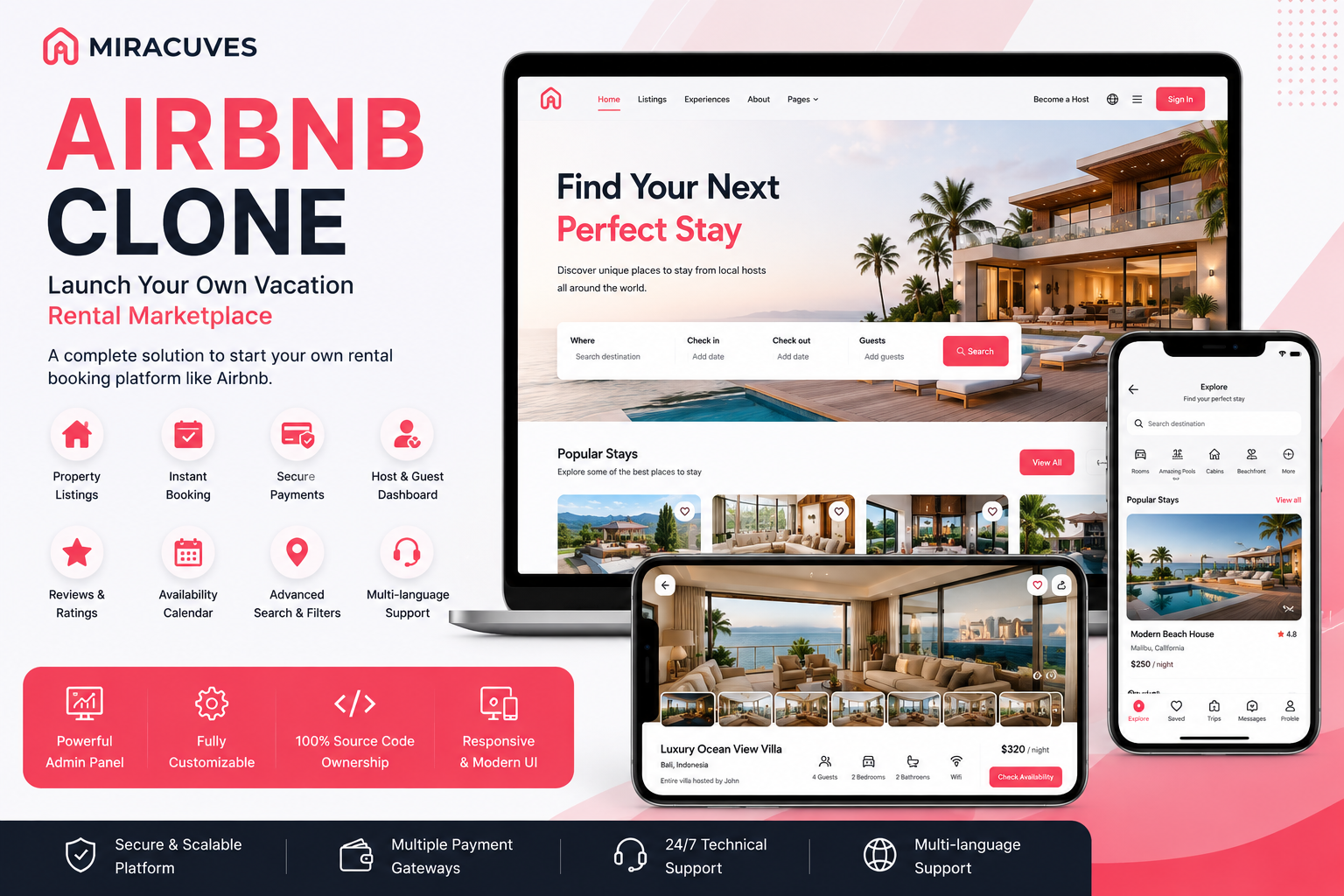
The vacation rental industry offers opportunities for startups, travel companies, property managers, and hospitality entrepreneurs. Travellers increasingly prefer digital platforms where they can compare accommodations, check availability, communicate with hosts, and complete bookings in one place.
An Airbnb Clone App provides the technical foundation for launching a branded property rental marketplace. It connects travellers looking for accommodation with hosts who want to list and monetize their properties.
However, building a successful vacation rental platform requires more than copying the design of an existing application. The business must provide accurate availability, verified listings, secure transactions, transparent pricing, effective communication, and dependable customer support.
What Is an Airbnb Clone App?
An Airbnb Clone App is a customizable vacation rental marketplace inspired by the core booking model of popular accommodation platforms.
Property owners can register as hosts, create listings, upload images, define amenities, manage availability, set rental prices, receive booking requests, and track their earnings.
Travellers can search for properties based on destination, travel dates, guest count, price, property type, and amenities. They can compare listings, communicate with hosts, make payments, manage reservations, and submit reviews after completing a stay.
The marketplace owner manages the complete platform through an administrative dashboard. The current solution includes booking management, secure payments, host verification, real-time availability, AI-powered recommendations, white-label branding, source-code access, and app-publishing support.
Why Launch a Vacation Rental Marketplace?
A vacation rental platform can serve audiences that are not fully addressed by large global marketplaces.
Instead of competing across every destination and property category, a new business can focus on a specific niche.
Possible marketplace ideas include:
- Luxury villa rentals
- Affordable student accommodation
- Pet-friendly vacation homes
- Corporate and business travel
- Eco-friendly properties
- Rural and farm stays
- Long-term remote-work rentals
- Event and wedding venues
- Beach houses and holiday apartments
- Accessible accommodation
- Religious and community stays
A focused marketplace can develop stronger relationships with local hosts and provide services designed around the needs of a particular traveller group.
Main Components of an Airbnb Clone Platform
A complete vacation rental marketplace generally includes separate interfaces for travellers, hosts, and administrators.
Traveller Application and Website
The traveller application is the main property discovery and booking interface.
Users should be able to enter a destination, select check-in and check-out dates, choose the number of guests, and view suitable properties.
Advanced filters can help travellers narrow their search by price, property type, bedrooms, amenities, ratings, accessibility, cancellation policy, and instant-booking availability.
Each property page should clearly present:
- Property photographs
- Accommodation description
- Location information
- Available amenities
- Guest capacity
- House rules
- Nightly price
- Additional charges
- Availability calendar
- Host information
- Ratings and reviews
- Cancellation conditions
The booking experience should remain simple across mobile and web devices.
Host Application and Dashboard
Hosts need a dedicated interface for managing their properties and reservations.
They should be able to create listings, upload images, describe available facilities, define guest limits, block unavailable dates, and set rental prices.
Hosts may also need tools for:
- Managing seasonal rates
- Reviewing booking requests
- Accepting or rejecting reservations
- Sending check-in instructions
- Communicating with travellers
- Viewing upcoming stays
- Monitoring completed bookings
- Checking earnings and payouts
- Updating property information
- Managing cancellation requests
A simple host dashboard can encourage property owners to keep availability, pricing, and listing information accurate.
Administrative Dashboard
The administrative dashboard acts as the operational control centre of the marketplace.
Administrators can manage travellers, hosts, properties, bookings, payments, commissions, disputes, cancellations, promotions, and content.
They can also review host verification documents, approve new property listings, monitor marketplace activity, and generate business reports.
The platform owner should be able to view information such as total listings, confirmed bookings, cancellation rates, host earnings, platform revenue, popular locations, and user activity.
Essential Airbnb Clone App Features
Advanced Property Search
Travellers should be able to find relevant accommodation without browsing hundreds of unrelated listings.
The search engine can combine destination, dates, property type, guest capacity, price range, amenities, and ratings.
A map-based search experience can also help users compare properties according to their location.
As the marketplace expands, spatial indexing, bounding-box filtering, and map clustering can help the platform return relevant listings without loading every property at once.
Real-Time Availability Calendar
Accurate availability is one of the most important parts of a rental marketplace.
When a reservation is confirmed, the selected dates should immediately become unavailable to other users. Hosts must also be able to block dates for maintenance, personal use, or offline reservations.
Without reliable calendar management, two travellers may attempt to reserve the same property for overlapping dates.
A stronger booking workflow can use database transactions, protected booking locks, timezone normalization, and external calendar synchronization to reduce double-booking risks.
Instant Booking
Instant booking allows eligible travellers to reserve a property without waiting for manual host approval.
This can reduce booking delays and improve conversions, particularly for travellers making urgent or last-minute plans.
Hosts should still be able to establish requirements such as verified identity, accepted house rules, minimum notice, and guest limits.
Dynamic Pricing
Rental demand can change depending on weekends, holidays, local events, seasons, and property availability.
Dynamic pricing allows hosts to adjust prices according to market conditions. They can also establish minimum stays, weekend rates, cleaning fees, deposits, taxes, and discounts for longer reservations.
The platform should clearly display the complete booking cost before payment.
Secure Payment Processing
Travellers need trusted and convenient payment options.
The marketplace can support cards, digital wallets, local payment gateways, deposits, partial payments, and other regional methods.
The payment workflow should record booking value, service fees, taxes, host earnings, refunds, and platform commissions.
Where required, funds may be held until a defined booking milestone before being released to the host.
Host and Guest Verification
Trust is essential when strangers are exchanging accommodation and payment through an online marketplace.
The platform can request identity documents, email verification, mobile verification, property ownership records, business licences, and banking information.
Administrators should review verification information before allowing hosts to publish listings or receive payouts.
Verification cannot remove every risk, but it can reduce fraudulent accounts and strengthen marketplace confidence.
In-App Messaging
Travellers may need to ask about parking, pets, accessibility, check-in times, nearby transportation, or property rules.
In-app messaging allows both parties to communicate without immediately sharing personal contact details.
Keeping communication within the platform can also help administrators investigate disputes.
Ratings and Reviews
Reviews help travellers evaluate properties and hosts before booking.
After a completed stay, guests can rate cleanliness, accuracy, location, communication, and overall experience.
Hosts may also review guests based on communication, behaviour, and compliance with property rules.
Only users connected to a verified reservation should be able to publish stay reviews.
Wishlist and Saved Properties
Travellers often compare several options before making a decision.
A wishlist allows users to save properties and return to them later. The platform can also use saved listings and search activity to improve property recommendations.
Multilingual and Multi-Currency Support
A rental marketplace may serve users from different locations.
Multilingual interfaces, local currencies, translated listing details, and regional payment options can make the platform easier to use in new markets.
These capabilities are especially important for businesses planning expansion across cities or countries.
AI-Powered Recommendations
Personalized recommendations can help travellers discover properties that match their interests.
Suggestions may be based on selected destinations, previous searches, budget, saved properties, preferred amenities, and booking history.
Recommendations should support property discovery while still allowing travellers to browse the complete marketplace.
Revenue Models for an Airbnb Clone Business
A vacation rental platform can generate revenue through several methods.
Booking Commission
The platform can deduct a percentage from every completed reservation.
The commission may be charged to the host, the traveller, or divided between both parties.
Guest Service Fees
A service charge can be added to the traveller’s booking total.
It should be shown clearly before payment to prevent unexpected charges.
Host Subscription Plans
Property owners can pay a monthly or annual fee to list and manage accommodations.
Premium plans may provide more listings, advanced analytics, promotional tools, or reduced booking commission.
Featured Listings
Hosts can pay to promote selected properties in search results, destination pages, or homepage sections.
Promoted properties should remain relevant to the traveller’s search and meet marketplace quality standards.
Value-Added Services
The platform may generate additional income through property insurance, photography, cleaning, airport transportation, concierge services, or listing management.
These services can create extra revenue while helping hosts operate more effectively.
Enterprise and White-Label Licensing
A platform owner may license the rental software to regional operators, agencies, or property-management businesses.
This can create a business-to-business revenue stream alongside regular marketplace bookings.
Steps to Launch an Airbnb Clone App
1. Choose a Target Market
Start by selecting the destination, property category, or traveller group the platform will serve.
Research local accommodation demand, competitors, average rental prices, seasonal changes, and traveller expectations.
2. Review Local Regulations
Short-term rental regulations vary between regions.
Review licensing, taxation, insurance, zoning, safety, privacy, and host-registration requirements before launching.
3. Define Host Verification Rules
Decide which documents and information hosts must provide.
Create a clear listing-review process that checks ownership, photographs, descriptions, amenities, location, and legal requirements.
4. Select a Revenue Model
Choose how the platform will earn through booking commissions, subscriptions, service fees, promoted listings, or additional services.
All charges should remain transparent for hosts and travellers.
5. Customize the Platform
Add the company name, logo, colours, domain, currencies, languages, property categories, payment gateways, service areas, and booking policies.
Miracuves provides a white-label Airbnb Clone foundation with guest and host workflows, administrative control, complete rebranding, source-code access, deployment assistance, free updates, and a standard six-day launch option for the ready-made setup.
6. Onboard Quality Hosts
A rental marketplace requires trustworthy properties before it can attract travellers.
Begin with a focused group of hosts and help them create complete listings with accurate prices, availability, amenities, and photographs.
7. Test the Booking Journey
Test registration, property search, map results, availability, payment, calendar updates, messaging, cancellations, refunds, reviews, commissions, and payouts.
The platform should also be tested on different devices and under slower network conditions.
8. Launch in a Focused Region
Launching in one city or destination makes it easier to verify properties, support hosts, manage disputes, and build local awareness.
The marketplace can expand after the initial booking process becomes stable.
Common Mistakes to Avoid
One common mistake is launching with incomplete or unverified listings. Poor photographs, inaccurate descriptions, and outdated calendars can quickly damage traveller trust.
Another mistake is displaying additional fees only at the final payment stage. The full booking cost should be visible before users commit.
Businesses should also avoid unclear cancellation policies, delayed host payouts, weak dispute management, poor customer support, and unreliable calendar synchronization.
The marketplace must balance the needs of travellers, hosts, and platform administrators. Ignoring one side of the marketplace can limit growth.
Final Thoughts
An Airbnb Clone App can help entrepreneurs launch a structured vacation rental marketplace without developing every technical component from zero.
It connects travellers, hosts, and platform operators through property search, booking calendars, payments, communication, reviews, pricing, and administrative controls.
Technology provides the foundation, but long-term success depends on verified properties, reliable hosts, transparent charges, secure payments, responsive support, and a focused market strategy.
By starting with a clearly defined niche and improving the marketplace according to real booking behaviour, businesses can build a scalable rental platform that creates value for both property owners and travellers.

 Arabic
 French
 Spanish
 Portuguese
 Deutsch
 Turkish
 Dutch
Dutch
 Italiano
 Russian
 Romaian
 Portuguese (Brazil)
 Greek
Greek