


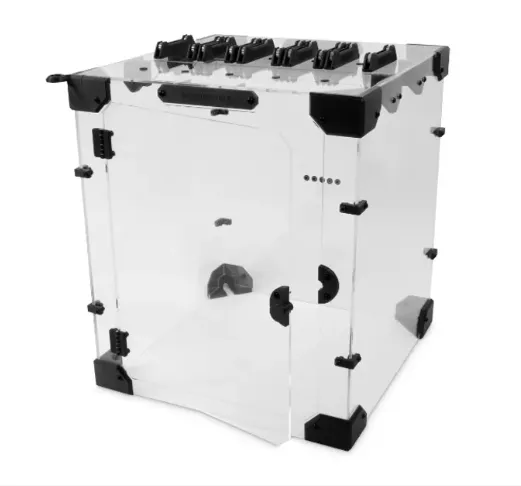
A consistent printing environment is one of the most important factors in achieving high-quality 3D prints. Even with advanced printers and premium filaments, external conditions like airflow, temperature changes, and dust can negatively affect results. This is where a universal 3d printer enclosure becomes valuable.
It creates a controlled printing chamber that stabilizes conditions around the printer, helping users achieve more accurate, reliable, and repeatable prints.
Why Print Stability Matters in 3D Printing
Print stability refers to how consistently a printer can maintain layer alignment, adhesion, and dimensional accuracy throughout a job. When stability is poor, users often face issues such as:
-
Warping or curling edges
-
Layer separation (delamination)
-
Uneven surface finish
-
Failed prints on tall models
-
Poor dimensional accuracy
These problems usually occur because the printed material reacts to changes in the surrounding air temperature and movement.
How an Enclosure Creates a Controlled Environment
A 3D printer enclosure works by isolating the printer from external environmental changes. It reduces airflow interference and maintains a more stable internal temperature.
Key environmental improvements include:
-
Reduced cold or hot air drafts
-
Stable chamber temperature
-
Lower dust contamination
-
Controlled airflow around the model
-
Consistent cooling conditions
By controlling these factors, the printing process becomes more predictable and stable.
Temperature Control and Its Impact on Print Quality
Temperature is one of the most critical factors in 3D printing performance. Materials like ABS, ASA, and Nylon are especially sensitive to rapid cooling.
A universal 3d printer enclosure helps maintain consistent heat levels inside the chamber. This leads to:
-
Stronger layer bonding
-
Reduced shrinkage issues
-
Fewer cracks in large parts
-
Improved surface finish
-
Better performance with engineering filaments
When the temperature remains stable, the material behaves more consistently throughout the print.
Improved Layer Adhesion and Structural Strength
Layer adhesion is the bond between each printed layer. Weak adhesion leads to brittle parts and structural failure.
With a stable enclosure environment, the filament cools at a controlled rate, which improves bonding between layers.
Benefits of better layer adhesion:
-
Stronger functional parts
-
Increased durability
-
Better mechanical performance
-
Reduced print failures
This is especially important for engineering, prototyping, and industrial applications.
Reduced Warping and Print Failures
Warping is one of the most common 3D printing issues, especially with high-temperature filaments. It happens when different sections of a print cool at different speeds.
An enclosure helps solve this problem by:
-
Maintaining even heat distribution
-
Preventing sudden cooling at edges
-
Reducing material contraction stress
As a result, prints stay flat on the build plate and maintain their intended shape.
Better Performance with Advanced Filaments
A controlled printing chamber expands the range of usable materials. Many advanced filaments require stable conditions to perform properly.
Common filaments that benefit include:
-
ABS (Acrylonitrile Butadiene Styrene)
-
ASA (UV-resistant outdoor material)
-
Nylon (high strength and flexibility)
-
Polycarbonate blends
-
Composite filaments
Without an enclosure, these materials often fail due to uncontrolled cooling and airflow disturbances.
Cleaner Printing Environment
Dust, debris, and airborne particles can also affect print quality. Even small contaminants can stick to layers and create defects.
A 3d printer enclosure reduces these risks by protecting the printing area from external contamination.
Additional benefits:
-
Cleaner surface finish
-
Reduced nozzle clogging risk
-
Less maintenance required
-
More consistent print results
This is especially useful in workshops, garages, or shared workspaces.
Noise Reduction and User Comfort
While not the primary function, enclosures also help reduce noise generated by moving printer components. This improves the overall user experience, especially during long print jobs.
Users often appreciate:
-
Lower operational noise
-
Safer interaction with hot components
-
More organized workspace setup
Why a Universal Design Matters
The term universal 3D printer enclosure refers to a design that fits multiple printer sizes and brands. This flexibility makes it useful for makers, engineers, and businesses who may use different machines.
Advantages of universal compatibility:
-
Fits various printer models
-
Easier upgrades or replacements
-
Cost-effective compared to custom builds
-
Flexible workshop integration
This makes it a practical solution for both hobbyists and professionals.
Final Thoughts
A stable printing environment is essential for achieving high-quality 3D printed parts. By controlling temperature, reducing airflow disruptions, and protecting against dust, an enclosure significantly improves print reliability.
A universal 3d printer enclosure not only enhances print stability but also expands material compatibility and reduces failure rates. Whether for prototyping, functional parts, or professional production, it is one of the most effective upgrades for improving overall 3D printing performance.

 English
 Arabic
 French
 Spanish
 Portuguese
 Deutsch
 Dutch
Dutch
 Italiano
 Russian
 Romaian
 Portuguese (Brazil)
 Greek
Greek