


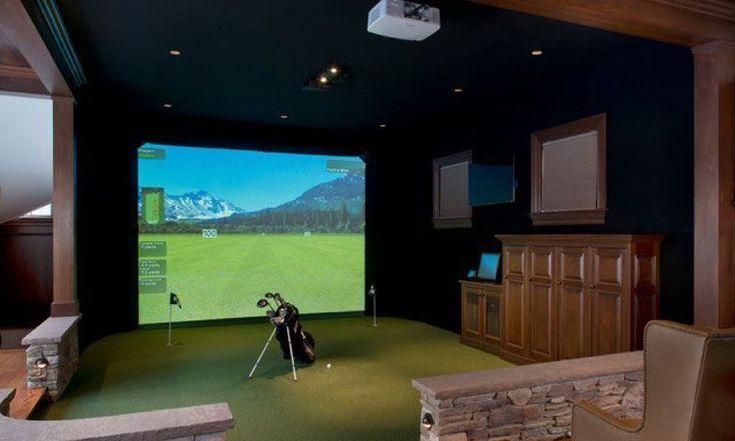
Golf has always been a sport of precision. Small changes in swing path, clubface angle, or ball contact can dramatically affect distance and accuracy. For decades, players relied on feel, coaching feedback, and ball flight observation to improve. Today, technology has added a powerful layer of insight through the use of a launch monitor and a golf simulator, allowing players to analyze performance and practice with greater accuracy in any environment.
If you are new to this technology, this guide explains what a launch monitor is, how it works, what data it provides, and why it has become an essential training tool for modern golfers.
What Is a Launch Monitor?
A launch monitor is a piece of golf technology designed to measure and analyze ball and club performance at impact. When you hit a shot, the system tracks how the club strikes the ball and how the ball travels immediately after impact. The collected data is then displayed in real time on a screen or connected device.
In simple terms, it turns every shot into measurable information. Instead of guessing why a shot went long, short, left, or right, you can see the exact numbers behind the result.
Why Launch Monitors Matter in Golf
Golf improvement often stalls because players cannot accurately diagnose problems. A tracking device removes uncertainty by providing objective feedback.
Benefits include:
-
Clear understanding of shot performance
-
Faster improvement through data-backed practice
-
Better consistency across clubs
-
Improved decision-making during training
For beginners, this means learning correct fundamentals early. For experienced players, it means refining performance with precision.
How a Launch Monitor Works
tracking device use advanced tracking technology to record shot data. The two most common technologies are:
Radar-Based Systems
Radar units track the ball by following its movement through the air. They are commonly used outdoors, where there is enough space for full ball flight.
Camera-Based Systems
Camera-based units use high-speed cameras to capture impact details. These systems are highly effective indoors and excel at measuring club and ball interaction.
Some modern systems combine both methods to deliver a more complete data set.
Key Data Metrics Explained
Understanding the numbers is essential to getting value from a tracking device. Below are the most important metrics beginners should know.
Ball Speed
This measures how fast the ball leaves the clubface. Higher ball speed generally leads to longer shots.
Club Speed
This indicates how fast the clubhead is moving at impact. It plays a major role in potential distance.
Launch Angle
The vertical angle at which the ball takes off. Too low or too high can reduce carry distance.
Spin Rate
This measures how much the ball spins in the air. Excessive spin can cause ballooning, while too little spin can reduce control.
Carry Distance
The distance the ball travels in the air before landing.
Total Distance
Carry distance plus roll after landing.
Smash Factor
A ratio comparing ball speed to club speed. It reflects how efficiently energy is transferred at impact.
Ball Data vs Club Data
tracking device information is often grouped into two categories:
Ball Data
Focuses on what the ball does after impact, including speed, launch, spin, and distance.
Club Data
Examines how the club moves through impact, such as club speed, angle of attack, and swing path.
Beginners can improve significantly by focusing first on ball data, while advanced players often rely on club data for fine-tuning.
Indoor vs Outdoor Use
One of the advantages of modern tracking devices is flexibility.
Indoor Practice
-
Ideal for year-round training
-
No dependency on weather
-
Immediate feedback in a controlled environment
Outdoor Practice
-
Full ball flight visibility
-
Real-world conditions
-
Useful for validating indoor results
Both settings are effective, and many golfers use a combination of the two.
Launch Monitor vs Golf Simulator
These terms are often confused, but they serve different purposes.
-
A Launch Monitors For Golf focuses on measuring and analyzing shot data.
-
A golf simulator uses that data to recreate virtual golf courses and gameplay.
Many simulators include built-in tracking systems, but a tracking device can also be used independently for pure practice and analysis.
Who Should Use a Launch Monitor?
This technology is not limited to professionals. It benefits a wide range of golfers.
Beginners
-
Learn correct swing fundamentals
-
Understand cause-and-effect early
-
Build consistency faster
Intermediate Players
-
Identify distance gaps between clubs
-
Improve accuracy and dispersion
-
Refine ball flight control
Advanced Golfers
-
Optimize tracking device conditions
-
Fine-tune equipment performance
-
Prepare for competitive play
How Launch Monitors Improve Practice Sessions
Traditional practice often involves hitting balls without clear goals. With a tracking device, practice becomes intentional and efficient.
You can:
-
Track progress over time
-
Set measurable improvement targets
-
Identify patterns in misses
-
Adjust technique based on evidence
This structured approach saves time and accelerates development.
Equipment Fitting and Optimization
Another major advantage is equipment analysis. tracking device data helps golfers understand how different clubs, shafts, and ball types affect performance.
Key benefits include:
-
Proper club selection
-
Improved distance consistency
-
Better control and accuracy
Instead of relying on feel alone, decisions are supported by measurable results.
Common Misconceptions
“Launch monitors are only for professionals”
Modern systems are designed for all skill levels and are increasingly accessible.
“The data is too complicated”
While the numbers may seem overwhelming at first, focusing on a few key metrics makes learning manageable.
“They replace coaching”
Technology complements coaching but does not replace instruction. Data works best when combined with proper guidance.
What Beginners Should Focus On First
To avoid information overload, beginners should prioritize:
-
Ball speed
-
Launch angle
-
Carry distance
-
Shot dispersion
These metrics provide a strong foundation for understanding performance without unnecessary complexity.
Cost Considerations
Prices vary depending on features, accuracy, and technology type. Entry-level options focus on essential metrics, while advanced systems offer deeper analysis.
When choosing a system, consider:
-
Practice environment (indoor or outdoor)
-
Level of detail needed
-
Long-term training goals
Investing in the right setup can provide years of value.
The Future of Launch Monitor Technology
As technology evolves, tracking device continue to become more accurate, compact, and user-friendly. Advancements in data visualization and integration with training software are making performance analysis more accessible than ever.
For golfers, this means better tools to understand their game and smarter ways to improve.
Final Thoughts
A tracking device is more than a training gadget—it is a powerful learning tool. By transforming every shot into actionable information, it helps golfers of all levels practice with purpose and confidence.
For beginners, it builds a strong technical foundation. For experienced players, it offers precision and refinement. Understanding how it works and how to use the data effectively can significantly accelerate improvement and make practice more rewarding.
Whether your goal is consistency, distance, or confidence, learning to train with accurate feedback can change the way you approach the game.

 Arabic
 French
 Spanish
 Portuguese
 Deutsch
 Turkish
 Dutch
Dutch
 Italiano
 Russian
 Romaian
 Portuguese (Brazil)
 Greek
Greek